Special Collections and Archives blog

November 23, 2015
by special collections & archives
Comments Off on Thanksgiving in the Archives

Thanksgiving in the Archives

For many, this week is shorter on work and lengthier on planning for/experiencing Thanksgiving. Whether it be through the gathering of friends and family, a game of football, shopping (in store/online), or binge-watching a newly-discovered television program, this is meant to be a time to unwind and gear up for December.

In recognition of Thanksgiving, Special Collections and Archives (SCA) would like to answer the fictional (but perhaps soon to be realized) research question: “What do you have here about Thanksgiving and such?”

To answer this question, we have to first pose a followup question about a time frame that is of interest to our patron. While information related to pre-colonial (thus ‘written’) cultures in the Southwest is sparse, it is nonetheless important to acknowledge that indigenous people have lived here for thousands of years and were not documenting themselves using media (paper, photography, film) that colonial society introduced and with which we have now become accustomed. Colonial history in the Southwest is comparatively recent on a global scale, beginning with Spanish exploration in the 1530s; Mexican independence from Spain in the 1810s; American acquisition of the territory of Arizona in 1848; and finally Arizona statehood in 1912. Considering Thanksgiving in the United States hails back to the Pilgrims landing on Plymouth Rock in 1620, most documentation related to celebrating the holiday between 1621 and 1848 will reside elsewhere and mostly with repositories on the east coast that document the history of the American colonies. It is also worth noting that photography as a medium had just been born in 1839 with the advent of daguerreotype technology, which would open up many new and exciting ways of conveying information.

Briefly, SCA has primary source material that describes the celebration of Thanksgiving from the mid-to-late-19th century to present, with the vast majority covering life in the mid-20th century to present. Start your search for digitized content at our main page here.

pg_2

Letters to Samuel E. Day, Sr., from Dan Mitchell [constructed title], 1908. MS.89: Day Family Collection.

Thanksgiving Day 1986 Our Lady of Guadalupe, Father Dobrowski. NAU.PH.2013.11.1.50. Our Lady of Guadalupe Church Collection.

Thanksgiving Day, Our Lady of Guadalupe, Father Dobrowski, 1986. NAU.PH.2013.11.1.50. Our Lady of Guadalupe Church Collection.

Our fictional patron may ask about written or oral primary source accounts of Thanksgiving in the Southwest and for that several interesting results can be found. Numerous audio and video files document oral histories in which narrators discuss Thanksgiving, either personally or factually. Many of these speakers were featured as part of the Flagstaff Public Library Oral History Project (1975-77) or were recorded as part of SCA’s 1998-2000 United Indian Traders Association Collection. Willie Coin (in 1975) describes his perspective on the holiday as a Hopi person and wonders why its significance has faded away so much. In 1976, Kathryn Rucker reminisced about the amount of family time involved with Thanksgiving as compared to Christmas. In 1980, Myrna Hillyard recalls being asked to speak about the Apache and their first Thanksgiving. In 1999, Mary Bailey described how she would cook Thanksgiving dinner for the Navajo and that they would refer to it as “Little Christmas.” In 2000, Colina Yazzie remembers her mother’s recollection of giving birth to her on Thanksgiving day. In 2008, Nat White discussed a-then yearly “Turkey Trot” that took place at Buffalo Park in Flagstaff.

While digitized content is a great beginning to our patron’s search on such a broad topic, it would also be very helpful to do a search at Arizona Archives Online for any material that may not have been digitized. A simple search for the word “Thanksgiving” among SCA’s collections reveal 13 unique collections in our repository that cover myriad related subjects. Our patron, upon review of these finding guides, may request that a series of boxes and folders be pulled in order to review their contents for relevance.

Of course, a robust search strategy would not be complete without a review of any publications (published books etc.) on the topic of Thanksgiving that are found through the library’s main catalog.

We hope that these search strategies can be applied successfully across a range of topics of interest to our patrons. We enjoy the challenge of–and being engaged with–finding new and exciting historic information that is being interpreted and disseminated in multiple ways in archival repositories across the world.

Happy Thanksgiving from SCA!
 

October 12, 2015
by special collections & archives
Comments Off on Book Review – The Spanish Frontier in North America

Book Review – The Spanish Frontier in North America

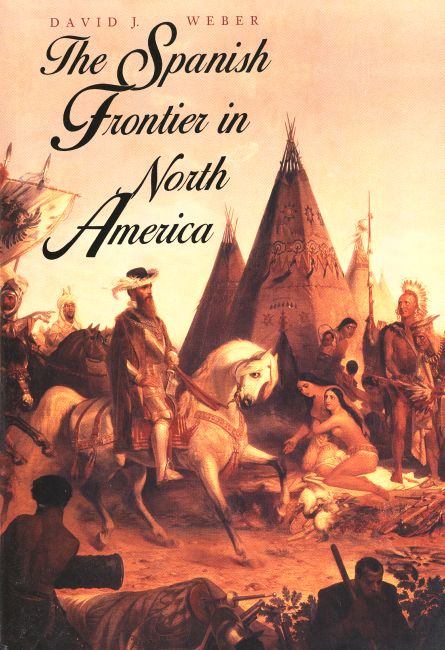
Spanish Frontier

Our second book review by Tom Schmidt looks at David Weber’s The Spanish Frontier in North America. 

David J. Weber (1940-2010) was one of the premier historians of the Spanish borderlands who taught at Southern Methodist University. I had the honor of meeting him in 2001 as a graduate history student at the University of San Diego. Weber sought to dispel the notion that United States history started entirely with the thirteen English colonies along the Atlantic seaboard. The Spanish Frontier in North America is a narrative of Spanish colonial history from California to Florida between 1513, when explorer Juan Ponce de León landed in Florida, to 1821, when Mexico won independence from Spain and control of the Southwest.

Although this book is a complete history of Spain’s empire in the American Southwest and Southeast, much of it focuses on Spanish relations with Native Americans. For years, the Spanish have been portrayed as uniquely cruel under the “Black Legend.” Instead, Weber argues that Spanish behavior was shaped by the 15th century Reconquista (“reconquest”), when the “pagan” Moors and Jews were driven out of Spain. In the Spanish mission system in the Southwest, Spanish Franciscans exploited Indian labor. However, harsh treatment of Native Americans was not confined to the Spanish; for example, at Jamestown, Virginia the English committed numerous atrocities against Indians. Weber offers an excellent analysis of the causes and events of the Pueblo Revolt in 1680 in New Mexico. After the Spanish restored order in New Mexico they fought together with Pueblo Indians against attacks from Apache and Navajo Indians and other threats.

One of the most interesting aspects of Weber’s book is the discussion of human and environmental transformations of Spain’s presence in North America. Throughout North America the Spanish introduced domestic animals, including sheep in the Southwest. Sheep play an important role in Navajo culture where wool is woven into textiles. Horses completely transformed the Apache, Comanche, and Indians of the Great Plains into powerful societies and brought further ecological changes. Grazing animals transported Old World grasses and the Spanish brought new plants, including watermelon and peach seeds. The presence of the Spanish mission system in California and throughout the Southwest is testimony of the Spanish period.

Many excellent titles have been published about Spanish borderlands history since Weber’s book, including James Brooks’ Captives and Cousins: Slavery, Kinship, and Community in the Southwest Borderlands (2002) and Juliana Barr’s Peace Came in the Form of a Woman: Indians and Spaniards in the Texas Borderlands (2007). (Both titles are available at Cline Library). More scholarship will likely build upon Weber’s fine work.

Weber, David J., The Spanish Frontier in North America (New Haven and London: Yale University Press, 1992).


To read other book reviews by Tom, please visit his blog Reader’s Advice

October 8, 2015
by special collections & archives
Comments Off on Book Review – Shadows at Dawn: A Borderland Massacre and the Violence of History

Book Review – Shadows at Dawn: A Borderland Massacre and the Violence of History

9781594201936

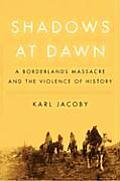
Our volunteer, Tom Schmidt, would like to share his book review of Shadows at Dawn: A Borderland Massacre by Karl Jacoby.

Here’s a teaser of his review…Western American history is dominated by violence toward Native Americans, most notably the Bear River Massacre of the Shoshone Indians of 1863 and the Wounded Knee Massacre of the Lakotas in 1890. However, one massacre that has not attracted much attention until recently is the 1871 Camp Grant massacre in the Arizona borderlands. Unlike the other incidents, there were more sides than whites and Indians. On April 30, 1871, a force of Anglo Americans, Mexican Americans, and Tohono O’odham Indians attacked a camp of Apache Indians near Tucson, killing scores of women and children. All of the parties involved had a history of conflict with the Apaches.

To read the full review, please visit Tom’s blog Reader’s Advice.

October 5, 2015
by special collections & archives
Comments Off on October is American Archives Month

October is American Archives Month

Screen Shot 2015-10-05 at 7.29.43 AM

October is American Archives month and the Cline Library Special Collections and Archives is excited to share several of its treasures with you throughout the month.

Special Collections and Archives has two major collecting areas: the human and natural history of the Colorado Plateau and the institutional history, or University Archives. The department will make selections from each area of our collecting scope to highlight a few of our collections.

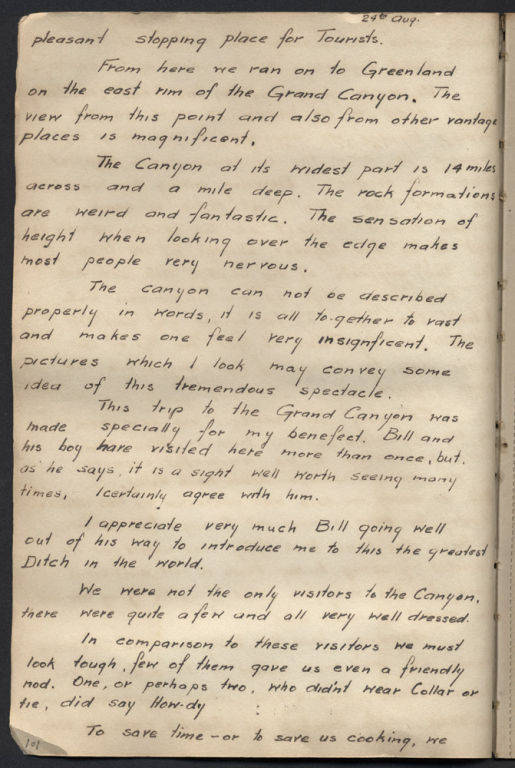
To kick off the month, we selected a 1936 travel journal of a gentleman named William “Wully” Wares to highlight an example of our Colorado Plateau collections. This exceptional photo-journal chronicles a 1936 motor trip which began in Butte, Montana and covered much of the Southwest. William Wares describes excavating a site at Awatobi, hunting mountain lions in Utah, and the beauty of numerous geographic landmarks such as the Grand Canyon and Goosenecks of the San Juan country.

Goosenecks, 1936

Goosenecks of San Juan Country, 1936

Grand Canyon National Park Pass, 1936

Grand Canyon National Park Pass, 1936

Journal Entry, August 24, 1936. Entering Grand Canyon National Park.

Journal Entry, August 24, 1936. Entering Grand Canyon National Park.

Journal Entry, August 24, 1936. Entering Grand Canyon National Park.

Journal Entry, August 24, 1936. Entering Grand Canyon National Park.

Photographs from Grand Canyon National Park, 1936

Photographs from Grand Canyon National Park, 1936

Photographs from Grand Canyon National Park, 1936

Photographs from Grand Canyon National Park, 1936

The journal also mentions Yellowstone National Park and the Teton mountains. An Anglo, Wares made cultural observations about the Navajo and Hopi as well as the inhabitants of Mormon towns. Some of the pages in this journal contain images of culturally sensitive material. The culturally sensitive material remains part of the original diary; however, Special Collections and Archives has elected not to provide online access to the culturally sensitive material out of respect to the Native American communities those images document.

The entire journal can be viewed online via our Colorado Plateau Archives here. The finding aid for the collection can be found at the Arizona Archives Online here.

Cline Library Special Collections and Archives will be partnering with three other institutions in Flagstaff to celebrate American Archives Month: The Arizona Historical Society, Northern Division; Lowell Observatory; and the Museum of Northern Arizona. Please feel free to visit their sites to learn more about the history and archives of northern Arizona.


October 3, 2015
by special collections & archives
Comments Off on Special Collections and Archives Welcomes Volunteer Tom Schmidt

Special Collections and Archives Welcomes Volunteer Tom Schmidt

tom schmidt

Tom Schmidt Enjoying New Years in Flagstaff in front of the Weatherford Hotel. Photo courtesy of Tom Schmidt

Special Collections and Archives has the fortune of having wonderful and dedicated volunteers who steadfastly and meaningfully contribute to the department. One of our more recent volunteers is a librarian named Tom Schmidt. Tom has worked over 10 years in public and museum libraries in Florida, New Mexico, and most recently, the Flagstaff City-Coconino County Library and the Museum of Northern Arizona. He also enjoys history (particularly Southwest). He received his master’s degree in history from the University of San Diego (go Toreros)  and later a master’s degree in library and information science from the University of Illinois Urbana-Champaign (go Fighting Illini). Despite living all over the country, he considers himself a Southwest native.  Tom is volunteering in the department by helping us with our monograph collection.

Like so many of us, Tom loves reading and history. He combined these two passions and is now making selections from our monograph collection and reviewing those books on his blog Reader’s Advice! He is very excited at reviewing books from the Special Collections & Archives and wants to focus on the different peoples of the Southwest/Colorado Plateau and their interactions with each other and the natural environment, and how history affects the future of the region.

Stay tuned for weekly book reviews from Tom, and if you see him in the library or around town, please say hello!

September 22, 2015
by special collections & archives
Comments Off on Collection Pickups: Professional Peril?

Collection Pickups: Professional Peril?

In an ideal world, donors would submit collections to Special Collections and Archives (SCA) in as pristine a manner possible: boxes would be clearly labeled and the contents organized and titled appropriately; contents would be in excellent stable condition; and the threat of pests (insects etc.) would be minimal to none. The idea that a box of material–whether textual or photographic–could be a danger to a person’s health seems a little out there.

Unfortunately this is a reality that many archivists and librarians face on the job; Post graduation, recently-minted professionals would never have imagined the sorts of environments they would be exposed to while collecting valuable historical documents. Mold/mildew, mice/rats, snakes, spiders, book lice, chemicals, and other biohazards are often parts of the job that are less than glamorous and certainly seldom publicized.

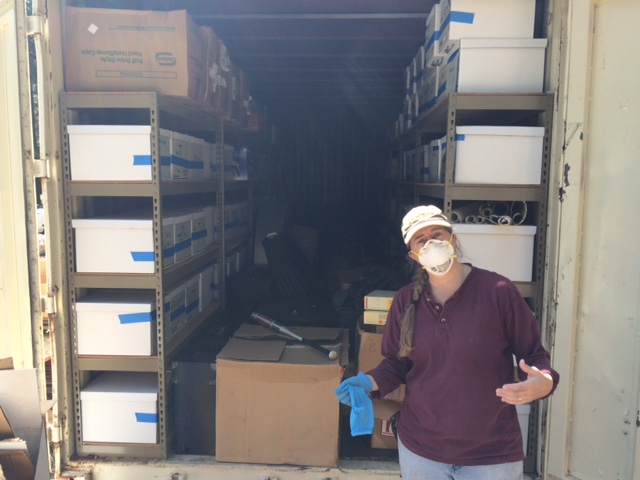
Recently, Special Collections and Archives was asked to retrieve materials stored in a older-model bleekers box that was offsite storage for the organization making the donation. The name and location of the material (and its donor) shall remain anonymous. Upon opening the door to the bleekers box, the immediate heavy musty odor suggested the very real likely presence of active mold and/or wood rot.

After clearing some space in the aisle, we were able to make headway and rebox some damaged boxes

After clearing some space in the aisle, staff were able to make headway and rebox some damaged boxes

The source of this odor was not immediately clear, but it wouldn’t take long to discover that a nickel-sized hole in the metal roof of the storage container had allowed water to enter for a number of years. Subsequently, numerous boxes and wooden shelves directly underneath had active (fuzzy) mold on them, preventing the retrieval team from even looking at the contents and assessing them for potential acquisition. Active mold contains tiny spores that are easily breathed in when disturbed; often these spores can attach themselves to tissues in the body and continue growing there, leading to serious medical issues. For this reason, archivists know that specialized retrieval by a trained team of experts in full protective gear is the only way active mold should be safely removed and managed. Inactive mold (dark and powdery) has fewer health concerns, but wearing gloves and using a mask to protect airways is always a good idea.

IMG_0904

The area directly underneath the hole in the ceiling/roof

The evidence of mold growth underneath the wooden shelves is apparent

The evidence of mold growth underneath the wooden shelves is apparent

IMG_0910

SCA staff demonstrating responsible gear for retrieving materials in less than ideal conditions.

However, all is not lost! There are many safety precautions that can be taken to mitigate exposure and potential illness when working with at-risk materials. Prior to commencing work, SCA staff put on protective nitrile gloves; these were swapped out regularly throughout the day. One member of the staff regularly wore a protective mask as she was making regular trips in and out of the box, while two other staff were predominantly stationed in the outdoors where there was less risk of exposure. Out of approximately 125 boxes stored in the bleekers box, the contents of 91 were identified as being in stable condition. After re-housing them in new boxes (and retaining all contextual information written on the boxes), the old boxes were collapsed and discarded or recycled. A further 17 boxes were experiencing accelerated mold growth and were not touched. Other boxes contained information that was of no interest to SCA. It is anticipated that a future visit to the bleeker’s box by a special team of pest professionals will be undertaken to retrieve the remaining 17 moldy boxes safely.

AND the story is not over. To eliminate other pests (such as silverfish, spiders, beetles, and book lice) that were not immediately seen in the material, these 91 boxes will be plastic wrapped on-site and sent to a large walk-in freezer for one-week of freezing. This step is critical so that SCA does not unwillingly introduce pests to collections presently housed in its storage facility. Altogether it is anticipated that this process will take over one month before all 91 boxes (and potentially some of the other 17 boxes) are all housed in SCA and ready for a formal review for appraisal, arrangement & description, and digitization purposes.

In closing, SCA will leave you and our future donors with some recommendations for storing your material so that the scenario above can be avoided.

  • Ensure the storage environment is sealed from exposure to the elements (check for leaks, cracks, and points of entry for insects/rodents)
  • Wherever possible, provide a consistent year-round temperature and relative humidity. While this is an ideal, new research suggests that materials are hardier than previously thought and can withstand some degree of seasonal fluctuation (winter to summer and vice-versa; monsoon activity) that can affect either temperature or relative humidity
  • Mitigate the level of light beaming down directly on materials or the boxes in which they are contained. Light damage will rapidly deteriorate these materials. Most materials prefer environments as dark as possible.
  • Use acid-free (and preferably waterproof/resistant) boxes and file folders/supplies to store documents/materials
  • Organize and inventory boxes in a manner conducive to eventual transfer in the event you move or you wish to donate materials to an archival repository.

July 28, 2015
by special collections & archives
Comments Off on 101 Years Ago Today – World War I Declared

101 Years Ago Today – World War I Declared

On July 28th, 1914–exactly 101 years ago today–Austria-Hungary declared war on Serbia. Many pinpoint this date as the beginning of the ‘Great War,’ which would soon involve many other nations in a battle that would become more commonly known as World War I. The United States formally declared war against Germany on April 6, 1917 – almost three years later. Special Collections and Archives has combed its digital holdings and would like to offer the following items that focus regionally on this historic war and the brave soldiers who fought for this country.

Harold Blome's Diaries, 1912-1918. MS.91.

Harold Blome’s Diaries, 1912-1918. MS.91

Red Cross Dog of WWI [standing in front of Babbitt Bros. Trading Company]. NAU.PH.412.1.41

World I Soldiers at Grand Canyon, 1917 ca. NAU.PH.568.8198

World I Soldiers at Grand Canyon, 1917 ca. NAU.PH.568.8198

Group of Men from Flagstaff, Arizona that Served in World War I, 1917 ca. AHS.0123.00014

A Patriotic Parade on the Campus During WWI. Morton Hall in Background, 1917. NAU.ARC.1918-6-1.

A Patriotic Parade on the Campus During WWI. Morton Hall in Background, 1917. NAU.ARC.1918-6-1.

World War I United War Work Drive; Two Women and Soldier Standing in Front of UWW Posters, 1918. AHS.0125.000007

World War I United War Work Drive; Two Women and Soldier Standing in Front of UWW Posters, 1918. AHS.0125.000007

Verde Copper News War Headlines, 1918. NAU.PH.231.303

Verde Copper News War Headlines, 1918. NAU.PH.231.303

Screen Shot 2015-07-28 at 10.09.18 AM

Oral History Interview with Ruth Mary Griffin and Agnes Anderson, 1975. NAU.OH.28.2

July 17, 2015
by special collections & archives
Comments Off on A Legacy of Canyon Adventure – George Billingsley Collection

A Legacy of Canyon Adventure – George Billingsley Collection

If you haven’t ventured below the rim of the Grand Canyon, you’re missing the best part!  For those with a more adventuresome personality (and extra leisure time), the panoramic landscape, geology, as well as unique flora and fauna are waiting to be experienced.  Regardless of the time of year and trail or site trekked,  the interior Canyon experience leaves a permanent mark on the visitor’s psyche.  For a select few, it is a passionate love affair and devotion to the Canyon that leads to numerous adventures and experiences with family and friends. Few have loved or experienced the Canyon to the depth and breath as George Billingsley.

Special Collections is proud to announce the opening of the George Billingsley collection.   This collection is the latest in a long list of archival collections documenting hiking and recreation in the Grand Canyon, including Harvey Butchart, Josef Muench, Fred and Margaret Eisement, P.T. Reilly, Tad Nichols, and Emery Kolb collections.  The Billingsley collection includes the original research and correspondence for his book, Quest for the Pillar of Gold: The Mines and Miners of the Grand Canyon (co-authored with Earle Spamer and Dove Menkes); professional publications; and published Colorado Plateau and Grand Canyon maps.  In additional, Billingsley has donated his annotated trip logs and thousands of photographs documenting his hiking and river excursions throughout the Grand Canyon region (1963-2002).  The first series of the Billingsley photographs have been digitized and are now online.  Stick around, there’s more to come!

July 17, 2015
by special collections & archives
Comments Off on The River Woman – Katie Lee

The River Woman – Katie Lee

Waterfilled Pothole at Llewellyn Gulch, 1958. Photo Courtesy of the Katie Lee Collection NAU.PH.99.3.1.15.22

Waterfilled Pothole at Llewellyn Gulch, 1958.
Photo Courtesy of the Katie Lee Collection
NAU.PH.99.3.1.15.22

For all the Katie Lee fans out there, check out this great interview with Ms. Katie courtesy of Arizona Public Media.

For the few who may not know Katie, she is a musician, activist, river runner, actress, writer, public speaker, and all round river goddess.  She’s still kicking @$$ at 95 years young and she will blow you away with her passion and her love of the river and wild places.

As Katie says, “I wouldn’t be anything like the person that I am until that river picked me up and took me along…”

Check out more of Katie here

July 17, 2015
by special collections & archives
Comments Off on The Struggle to Retain History and Culture

The Struggle to Retain History and Culture

It is the anniversary of Srebrenica, the massacre of a people and a culture. The wars in Bosnia destroyed families, homes, cities and factions made a point to destroy their “enemies” museums and libraries. It wasn’t just an annihilation of a people but their writings their histories and their culture. This is not the first time this has happened, World War II took a people then their homes, their goods, it took Countries and their art and sculptures and writings. It was a mass theft to be used by individuals and by a massive planned museum in Germany. Many pieces of art were destroyed or lost. All would have been when Hitler died because of an edict he wrote stating that all stolen art would be torched upon his death. If it were not for a few, the Louvre would not be as it is now, many churches and museum’s would be bereft of irreplaceable pieces.

Writings, documents, letters, art, sculpture, are not very exciting to many, but they show where we have come from, display our past in riots of color, softness and sheen of marble, crinkle of paper that displays words of those gone, but not to be forgotten.

They show us the thoughts of Lincoln, of Harriet Tubman, the humor of Twain, the courage of Douglas, of Grant, of Washington, Lafayette, of Mandela and Gandhii. The display the craft and genius of da Vinci, Rembrandt, Michelangelo, Picasso, The insane and glorious madness of Van Gogh, and Dali. This is what exists today but so ealily could have been destroyed.

Buddhist statues were blown up in Afghanistan as they did not fit with the regimes beliefs. Currently irreplaceable pieces of the past are lost to war and whoever gets to the town first, if it doesn’t fit they take a hammer or explosive to it. Ruins that show us the past, give us questions and answers give us wonder and joy are gone because they came under the wrong occupation.

Carlos Trujillo, date unknown Photo courtesy of the Carlos Trujillo Collection NAU.PH.2010.39.36

Carlos Trujillo, date unknown
Photo courtesy of the Carlos Trujillo Collection
NAU.PH.2010.39.36

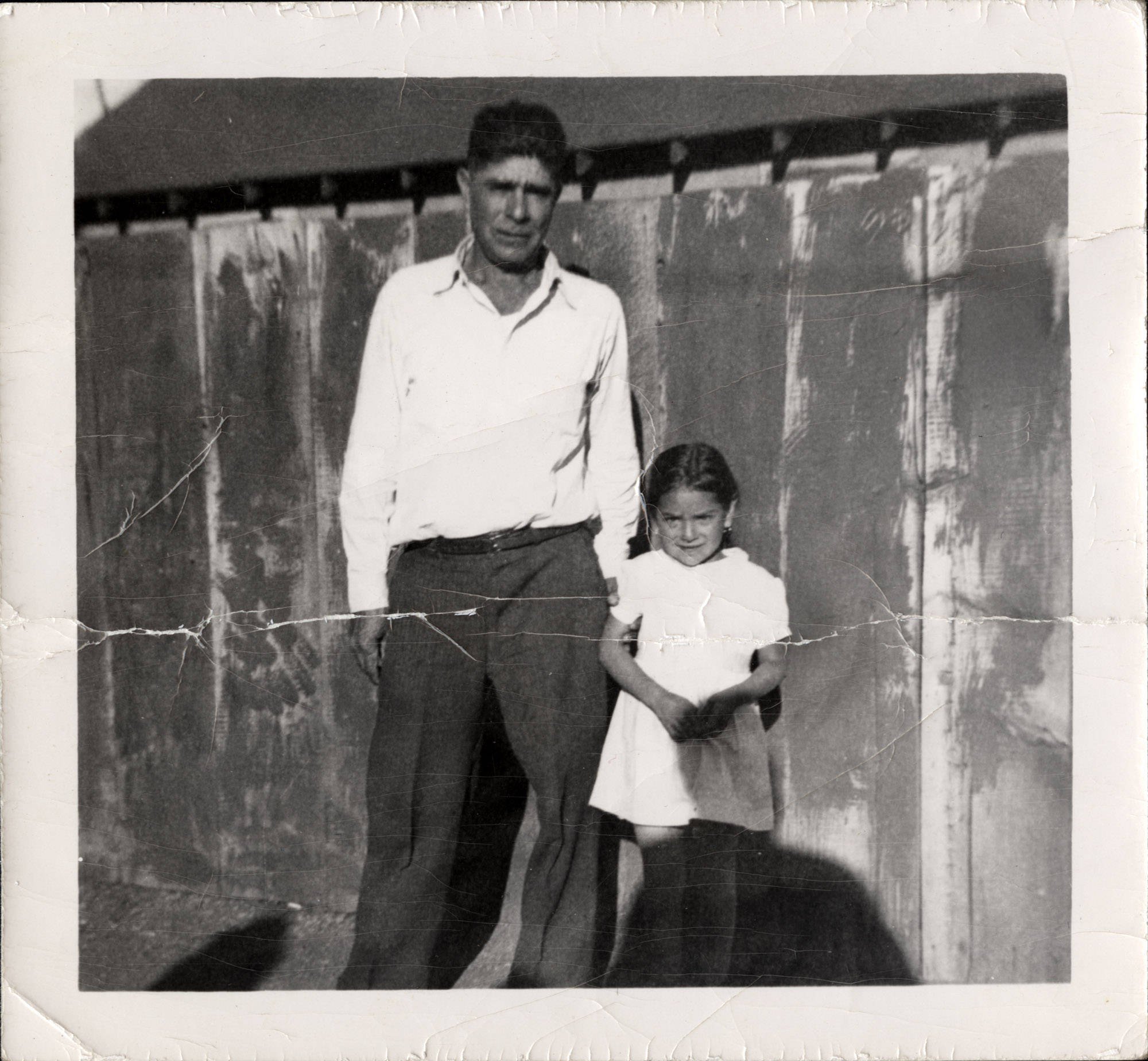
Locally we have the same issue. Carlos Trujillo born on January 19, 1906, resided on the south side of Flagstaff during the 1930s with his wife. Carlos eventually moved to Tourist Home on South San Francisco Street in Flagstaff. His collection of information concerning his employment as a laborer and as a member of a workers’ union in Flagstaff along with pay stubs, documentation, war rations, receipts, correspondence and some religious mementos along with 44 photographs were found in the trash, rescued and brought to Cline Library Special Collections. Mr. Trujillo’s documents and photograph provide a picture of life in Flagstaff in the early part of the 1900s. It provides information of a life lived here, working conditions finances a man’s life with his family in Flagstaff almost lost to a landfill.

Carlos Trujillo with a Young Girl, date unknown Photo Courtesy of the Carlos Trujillo Collection NAU.PH.2010.39.43

Carlos Trujillo with a Young Girl, date unknown
Photo Courtesy of the Carlos Trujillo Collection
NAU.PH.2010.39.43


Agapita Encinas Trujillo with Baby, Carlos Trujillo, Reymundo Ceballos, Lauriano Baca (from left to right) Photo Courtesy of the Carlos Trujillo Collection NAU.PH.2010.39.26

Agapita Encinas Trujillo with Baby, Carlos Trujillo, Reymundo Ceballos, Lauriano Baca (from left to right)
Photo Courtesy of the Carlos Trujillo Collection
NAU.PH.2010.39.26

Preservation and archivists are not very exciting and are considered old dusty people with old dusty things. They are not, they are young and old, short and tall, funny and irreverent, some even have tattoos and piercings, they all share something, a love of the past, and the knowledge that bringing it into the present, entices us with those who seek answers. History gives us a look into other lives, other times other realities that often so match our own, It is exciting and heartbreaking and joyful. So when you hear of an artifact, a geological dig, a painting, a manuscript a family’s history destroyed, think about it, what was lost? Not just a thing but the thoughts, the dreams, the realities of the people attached to it, and that loss can never be retrieved.

To learn more about Carlos Trujillo, please view the finding aid to his collection and see additional images from his collection on our digital archives.